Account-Based Marketing (ABM) Tools Every B2B Team Needs in 2026
Compare ABM tools for 2026, see where each fits, and choose a stack that matches budget, data, and sales-motion complexity.
 Admin
Admin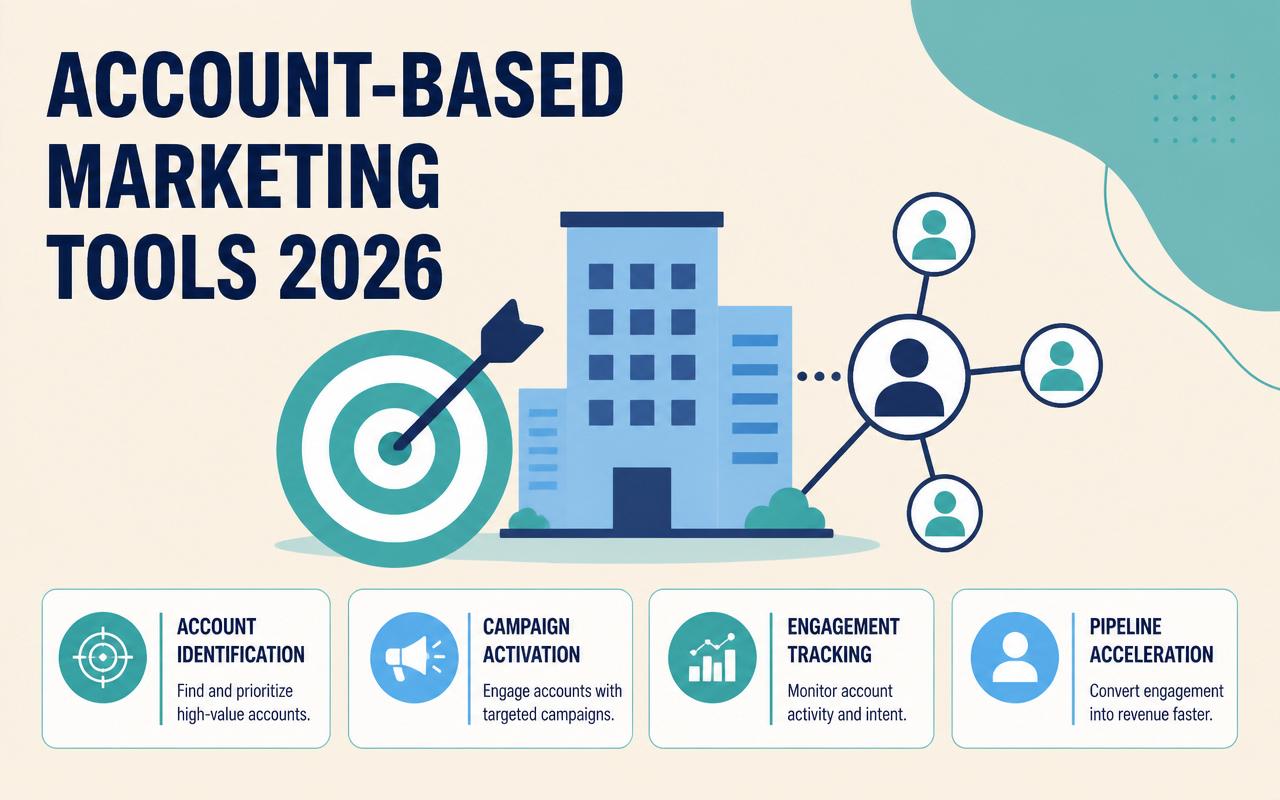
A lot of B2B teams still treat account-based marketing like a campaign layer bolted onto a demand gen stack. That usually fails in the same places: sales does not trust the account list, marketing cannot prove account engagement, and ops spends too much time stitching together data from CRM, ad platforms, and web personalization tools. In 2026, the practical question is not whether ABM works. It is which tools will help you target the right accounts, recognize buying signals early, coordinate ads and outreach, and keep reporting clean enough that revenue teams act on it. The right stack can shorten handoff time, reduce wasted media, and make account prioritization usable for both marketing and sales.
Why account-based marketing (ABM) tools matters in 2026
ABM tools matter because B2B buying has become more distributed, more anonymous, and more expensive to influence without account-level coordination.
- Buying committees are larger, so person-level lead scoring misses the account context sales needs.
- Website traffic is less identifiable, which makes first-party and third-party intent data more useful for account prioritization.
- Paid media costs keep rising, so concentrating spend on named accounts is easier to defend than broad top-of-funnel volume.
- RevOps teams need cleaner attribution across ads, CRM, and automation platforms, not another dashboard with vanity metrics.
- Personalization has to happen at the account level across ads, site content, outbound, and email, or the experience feels disconnected.
- AI features are only useful when the underlying account data, routing rules, and audiences are already structured well.
The 10-12 account-based marketing (ABM) tools to watch in 2026
Demandbase
Demandbase is built for teams that want one operating layer for account identification, advertising, website personalization, and sales signals. Its strength is breadth: you can bring target-account strategy, intent, and on-site experiences into a single system instead of managing separate point tools. That matters for larger B2B teams where marketing, SDR, and sales leadership all want a shared account view. Demandbase tends to fit organizations that already have enough pipeline volume to justify heavier setup and more deliberate governance around account lists and segment logic.
- Intent data and account identification
- Display and LinkedIn audience activation
- Website personalization and account-specific messaging
- Sales intelligence and account insights
- CRM and MAP integrations
Pricing is typically contact sales. Best fit: enterprise and upper mid-market teams with a defined target-account model and dedicated ops support.
6sense
6sense is strong when you care about spotting in-market accounts before they raise their hand. It combines predictive signals, intent, and workflow support to help marketing and sales rank accounts by likelihood to engage. The practical use case is not just insight; it is operationalizing that insight into routing, ad targeting, and SDR prioritization. Teams that run longer sales cycles often like 6sense because it helps them focus on accounts that are moving without waiting for form fills to show up.
- Predictive account scoring
- Intent signal aggregation
- Audience creation for paid media
- Account and contact enrichment
- Sales alerts and prioritization
Pricing is typically contact sales. Best fit: mid-market and enterprise teams with long sales cycles and enough data maturity to act on intent signals quickly.
Terminus
Terminus is often used by teams that want ABM execution without making the stack too complex. It covers account-based advertising, audience management, website engagement, and reporting in a way that is usually easier to operationalize than a heavily customized enterprise platform. That makes it appealing for marketers who need to launch account programs without months of modeling. It is also a common choice for teams that want a practical bridge between brand activity and pipeline influence.
- Account-based ad targeting
- Engagement measurement
- Website conversion tools
- Audience segmentation
- Campaign performance reporting
Pricing is typically contact sales. Best fit: mid-market teams that want a focused ABM platform with less implementation overhead than a large enterprise suite.
RollWorks
RollWorks works well for teams that need account targeting and ad activation without a huge platform commitment. It is often attractive to marketers who already have a CRM and automation platform in place but need a cleaner way to build target-account audiences, run display campaigns, and see which accounts are engaging. RollWorks also fits organizations that want a simpler motion for sales alignment, especially when the goal is to move from generic demand gen toward account-level prioritization without overbuilding the process.
- Target account identification
- Display advertising and retargeting
- Audience segmentation
- Engagement tracking
- CRM and marketing automation integrations
Pricing is typically contact sales. Best fit: small to mid-market B2B teams that want a lighter ABM platform for account ads and prioritization.
HubSpot ABM
HubSpot’s ABM capabilities are most useful when the team already lives in HubSpot and wants account-based structure without adding another vendor. The value is convenience: you can tie account lists, lifecycle stages, workflows, and reporting to a familiar system. It is not the deepest ABM product on this list, but for teams that care more about execution speed and adoption than advanced intent orchestration, it can be enough. The trade-off is that you may outgrow it if your account motions become more sophisticated.
- Target account lists
- ABM reporting and segmentation
- Workflows tied to account activity
- CRM and email automation
- Integration with ads and sales tools
Pricing varies by HubSpot tier; starts around $15/user/month for core CRM entry points, but ABM-relevant capabilities often require higher tiers and add-ons, verify current pricing. Best fit: smaller teams already standardized on HubSpot.
Salesforce Marketing Cloud Account Engagement
Salesforce Marketing Cloud Account Engagement, formerly Pardot, is a better fit for Salesforce-centered teams that want account-based programs tied to their CRM process. Its advantage is governance: segmentation, scoring, and automation can align closely with Salesforce objects and sales workflows. That makes it useful when marketing needs to work inside a broader revenue architecture rather than as a separate demand gen engine. The main drawback is that value depends heavily on how clean your Salesforce setup is.
- Lead and account scoring
- Automated nurture and segmentation
- CRM synchronization with Salesforce
- Engagement tracking and reporting
- Sales handoff workflow support
Pricing is typically contact sales. Best fit: Salesforce-native teams that need account-level nurture and reporting tied to CRM hygiene.
Madison Logic
Madison Logic is known for ABM media and content syndication tied to account engagement. It is a good option when a team wants to reach named accounts through content-based demand programs and track where accounts are consuming assets. That makes it especially relevant for teams that rely on educational content, webinars, and long nurture paths. Compared with all-in-one suites, Madison Logic can be a narrower but useful choice when media activation and account engagement measurement are the priority.
- Account-based content distribution
- Media activation across channels
- Engagement tracking by account
- Audience targeting
- Performance measurement for content programs
Pricing is typically contact sales. Best fit: B2B teams that rely on content syndication and want account-level engagement visibility.
Metadata.io
Metadata.io is built for paid acquisition teams that want better control over B2B ad experiments and pipeline generation. Its strength is the workflow around launching, testing, and optimizing campaigns across channels with less manual setup. While it is not a traditional ABM suite in the same mold as Demandbase or 6sense, it can play an important role when your ABM program is media-led and you need fast audience testing, creative iteration, and pipeline attribution that marketing ops can actually manage.
- Cross-channel paid campaign orchestration
- Audience and experiment management
- B2B pipeline reporting
- Creative and landing page testing
- Marketing ops automation
Pricing is typically contact sales. Best fit: growth-oriented B2B teams running paid programs that need faster campaign iteration and cleaner testing.
Mutiny
Mutiny focuses on website personalization, which makes it useful when ABM success depends on what named accounts see after they arrive on the site. Rather than replacing your whole ABM stack, it helps convert account traffic with tailored messaging, dynamic content, and segment-specific experiences. That is especially valuable when you already have good account lists and intent sources, but your website still feels generic. Mutiny is strongest when marketing wants to move from targeting to conversion on high-value pages.
- Website personalization
- Segment-based messaging
- No-code page variants
- Integration with ad and CRM data
- Conversion-focused experimentation
Pricing is typically contact sales. Best fit: B2B teams that need personalized web experiences for named accounts without heavy engineering support.
N.Rich
N.Rich is a practical ABM option for teams that want account targeting, personalization, and campaign measurement without the complexity of the biggest enterprise platforms. It often appeals to marketers who need to build account programs across advertising and on-site experiences while keeping implementation manageable. The product is especially relevant for teams that want a tighter connection between target account engagement and pipeline reporting, not just media metrics.
- Account targeting and segmentation
- Personalized website experiences
- Advertising activation
- Engagement analytics
- Campaign measurement
Pricing is typically contact sales. Best fit: mid-market teams that want an ABM platform with a balanced mix of targeting and personalization.
Triblio
Triblio is a familiar name for account-based advertising and website personalization, particularly for teams that want to coordinate account messages across paid media and the web. It is useful when the ABM motion is centered on orchestrated campaigns rather than deep predictive analytics. Teams that want a clear line from target account list to ad exposure to site conversion often evaluate Triblio because the workflow is relatively straightforward compared with some larger platforms.
- Account-based advertising
- Website personalization
- Audience orchestration
- Engagement analytics
- Sales and marketing alignment tools
Pricing is typically contact sales. Best fit: mid-market B2B teams that want coordinated account campaigns and web personalization.
Influ2
Influ2 stands out because it focuses on person-level advertising inside named accounts, which can be useful when a sales team wants repeated exposure to specific buyers rather than broad account reach. It works well for motions where buying committees are known, the target list is disciplined, and sales wants to reinforce outreach with matched ad touches. That makes it a useful complement to broader ABM platforms, especially when the goal is to support reps and create more relevant touch patterns.
- Person-based advertising
- Named account and contact targeting
- Sales coordination
- Engagement measurement
- CRM integration
Pricing is typically contact sales. Best fit: teams that want highly targeted advertising to known buyers inside strategic accounts.
Comparison table
| Tool | Starting price | Best for | Standout feature |
|---|---|---|---|
| Demandbase | Contact sales | Enterprise ABM programs | Broad suite for targeting, advertising, and personalization |
| 6sense | Contact sales | Mid-market to enterprise teams | Predictive account scoring and in-market signal detection |
| Terminus | Contact sales | Mid-market ABM teams | Practical account-based advertising and engagement workflow |
| RollWorks | Contact sales | Small to mid-market teams | Simpler account targeting and ad activation |
| HubSpot ABM | Starts around $15/user/month for core CRM entry points, but ABM-related capabilities often require higher tiers and add-ons, verify current pricing | Smaller HubSpot-centered teams | ABM inside a familiar CRM and automation stack |
| Mutiny | Contact sales | Web conversion teams | No-code website personalization for target accounts |
| Influ2 | Contact sales | Teams targeting named buyers | Person-level advertising inside strategic accounts |
How to choose the right account-based marketing (ABM) tools
- Start with your operating model: one-to-one ABM, one-to-few, or one-to-many requires very different levels of data, content, and sales involvement.
- Check CRM and marketing automation compatibility first; if account objects, campaign fields, or activity sync are messy, reporting will break fast.
- Match the tool to your media plan. If you are not buying account-level ads, do not pay for a suite built around ad orchestration.
- Look at implementation load honestly. Some platforms need dedicated ops time, custom audiences, and governance rules before they are useful.
- Evaluate data quality and residency needs, especially if your team handles regulated industries or works across regions with strict privacy requirements.
- Ask about support response times, onboarding help, and training for SDRs and sales managers, not just marketing admins.
- Consider whether the platform can help with both activation and measurement. A tool that only finds accounts but cannot prove influence is hard to defend internally.
Suggested stack by company size
Small business / low budget
For a smaller team, the safest move is to keep the stack tight and choose tools that reduce manual work rather than add more dashboards. If you already use HubSpot, start there and add only one other platform for activation or personalization. The goal is to prove that account targeting improves conversion before you invest in a heavier system.
- HubSpot ABM
- RollWorks
- Mutiny
- Influ2
Mid-market or agency
Mid-market teams usually need stronger intent data, better audience orchestration, and more visible reporting for sales leadership. Agencies also need flexibility across clients, which makes platforms with clearer campaign management and segmentation useful. This is the range where you can justify a dedicated ABM platform plus a personalization layer.
- 6sense
- Terminus
- N.Rich
- Madison Logic
- Metadata.io
Enterprise
Enterprise ABM stacks tend to work best when they anchor on one core platform and integrate tightly with CRM, MAP, and ad platforms. These teams usually have more stakeholders, stricter governance, and larger target-account lists. The win is less about launching campaigns and more about standardizing how the company identifies, prioritizes, and converts accounts.
- Demandbase
- 6sense
- Salesforce Marketing Cloud Account Engagement
- Mutiny
- Influ2
Trends to watch in account-based marketing (ABM) tools for 2026
- Native account object sync between CRM and ABM platforms so lists, stages, and ownership stay aligned without manual exports.
- Better signal fusion across website behavior, ad exposure, product usage, and third-party intent so prioritization is less dependent on any single source.
- More granular personalization controls for high-value landing pages, pricing pages, and case-study paths instead of generic homepage swaps.
- Workflow automation that routes engaged accounts to the right SDR, AE, or customer marketer based on segment, geography, and buying stage.
- Cleaner measurement models that separate account engagement from actual pipeline influence, helping teams defend spend to finance and sales.
- Privacy-aware identity resolution that respects consent, regional data rules, and cookie loss while still supporting account-level targeting.
I learned the hard way that ABM software breaks fastest at the account model, not the ad setup. In one rollout, we pushed audiences before sales had agreed on account ownership, and the result was three reps calling the same companies while the dashboard looked healthy. We also misconfigured CRM sync rules, so contacts moved into the wrong account segments and nurture logic fired at the wrong time. The fix was boring but effective: clean the account hierarchy, define ownership rules, test syncs with a small seed list, and only then turn on paid audiences and personalization. The platform matters, but your field mapping matters more.
FAQs
What is the main job of an ABM tool?
An ABM tool helps you identify target accounts, prioritize them with data, activate campaigns across channels, and measure engagement at the account level instead of only at the lead level.
Do small businesses need ABM software?
Not always. Smaller teams can start with CRM segmentation and a lighter personalization or ad tool. Dedicated ABM software becomes more useful once account lists, sales coordination, and reporting need to scale.
Which ABM tools are best for Salesforce users?
Salesforce Marketing Cloud Account Engagement is the most natural fit for Salesforce-centered teams. Demandbase and 6sense also integrate well for account prioritization and activation.
How do intent data and ABM differ?
Intent data is one input inside ABM. ABM is the broader operating model that uses target accounts, content, ads, personalization, and sales coordination to move buyers through the funnel.
What should I measure in an ABM program?
Track target-account engagement, qualified meetings, opportunity creation, pipeline influence, and conversion by account segment. Do not rely only on clicks or impressions.
If you are choosing account-based marketing tools in 2026, start with the work you need the software to do, not the brand name. A platform that gives you cleaner account data, better sales alignment, and usable reporting will outperform a bigger suite you do not have time to implement correctly. For most teams, the next step is simple: define your target-account model, map your current CRM and MAP setup, and pilot one platform against a narrow segment before expanding the rollout. That approach exposes integration gaps early and keeps the budget tied to actual pipeline goals.
Pricing sources
All prices cited in this article are taken from each vendor's official pricing page. Vendors update pricing frequently — always confirm the current rate with the source before purchasing.
Related articles
Online Survey & Feedback Tools: Best Options for Customer Insights in 2026
Compare the best online survey and feedback tools for 2026, with pricing, use cases, features, and a practical buyer’s guide.
Admin
Customer Loyalty & Rewards Platforms for Retail Brands in 2026
Compare 2026 loyalty and rewards platforms for retail brands, with pricing, features, use cases, and selection advice.
Admin
Social Media Management Platforms: A 2026 Buyer's Guide
Compare 12 social media management platforms for 2026, with pricing, best-fit use cases, and a practical buyer framework.
Admin