Supply Chain Management Software: What to Look for in 2026
Choose supply chain management software in 2026 with the right planning, execution, and visibility features for your operation.
 Admin
Admin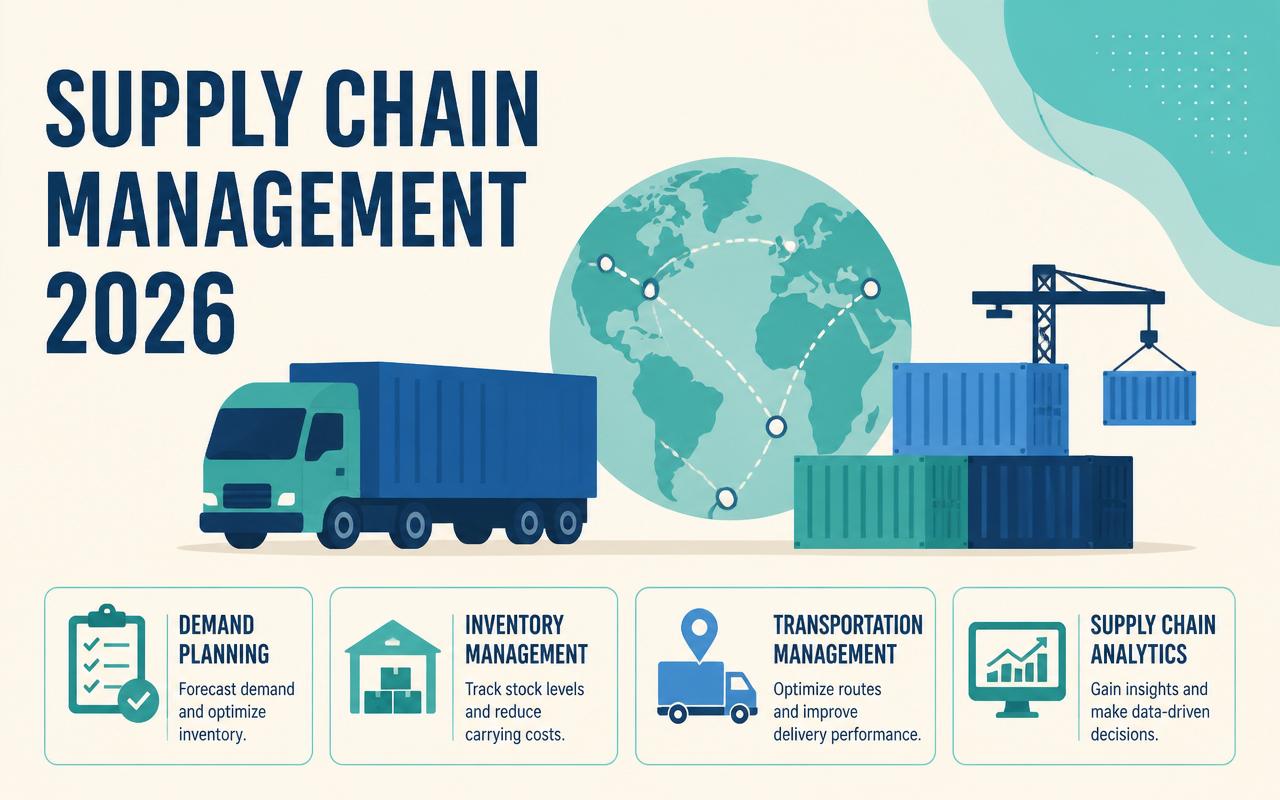
Supply chains do not fail only at the dock or in the warehouse. They fail when a planner cannot see supplier delays until the order is already late, when inventory sits in the wrong node, or when finance and operations are working from different assumptions. In 2026, supply chain management software is less about storing data and more about making faster decisions with fewer handoffs. The right platform helps you sense demand shifts earlier, coordinate suppliers and carriers, and keep service levels up without carrying extra inventory everywhere. For operators running lean teams, that difference shows up in fewer expedites, fewer surprises, and more reliable commitments to customers.
Why supply chain management software matters in 2026
Teams need systems that connect planning, execution, and exception handling without waiting on weekly meetings or spreadsheet merges.
- Tariff changes, port congestion, and supplier variability now affect plans faster than monthly planning cycles can absorb.
- Buyers expect tighter delivery windows, which makes order promising and inventory placement more important than raw stock levels.
- Many operations teams are dealing with fragmented ERPs, WMS tools, and carrier portals that do not share one version of demand or supply.
- Control towers and alerting now need to separate signal from noise, or planners spend all day on low-value exceptions.
- Inventory is too expensive to hold in the wrong place, so multi-echelon planning matters more than simple reorder points.
- Executives want scenario planning they can trust, not static reports that are outdated by the time they are reviewed.
The 10-12 supply chain management software to watch in 2026
SAP IBP
- Demand sensing and statistical forecasting
- Sales and operations planning workflows
- Inventory optimization and multi-echelon planning
- Scenario modeling with supply constraints
Contact sales for pricing. Best for enterprise and upper mid-market buyers already invested in SAP who need tightly governed planning.
Oracle SCM Cloud
- Supply chain planning and demand management
- Procurement and supplier management
- Order management and logistics orchestration
- Cloud updates without self-managed infrastructure
Contact sales for pricing. Best for mid-market and enterprise teams that want one suite across planning and execution.
Blue Yonder
- Demand and replenishment planning
- Fulfillment and inventory optimization
- Warehouse and transportation adjacencies
- Scenario planning for service and cost trade-offs
Contact sales for pricing. Best for retail, wholesale distribution, and complex fulfillment networks.
Kinaxis
- Concurrent planning across functions
- Rapid scenario modeling
- Supply risk and constraint management
- What-if analysis for service and cost outcomes
Contact sales for pricing. Best for high-complexity manufacturers and planners who need fast scenario turnaround.
Manhattan Associates
- Warehouse management system capabilities
- Order management and fulfillment orchestration
- Inventory visibility across nodes
- Support for omnichannel operations
Contact sales for pricing. Best for retailers, distributors, and fulfillment-heavy operations.
Infor Supply Chain
- Demand and supply planning
- Inventory and replenishment capabilities
- Cloud deployment options
- Integration with broader Infor ERP and operations tools
Contact sales for pricing. Best for mid-market manufacturers and distributors wanting a practical planning stack.
Coupa
- Spend management and procurement workflows
- Supplier collaboration and sourcing tools
- Policy-driven purchasing controls
- Visibility into commitments and approvals
Contact sales for pricing. Best for finance-aware operators focused on procurement discipline and supplier governance.
Anaplan
- Connected planning across functions
- Custom scenario modeling
- Inventory and capacity planning
- Collaboration for finance and operations
Contact sales for pricing. Best for teams that want flexible planning models across multiple departments.
o9 Solutions
- Enterprise planning and analytics
- Demand, supply, and inventory modeling
- Scenario and decision intelligence
- Cross-functional planning workflows
Contact sales for pricing. Best for large enterprises needing enterprise-wide planning intelligence.
Logility
- Demand planning and forecasting
- Inventory and replenishment optimization
- Supply planning and scenario analysis
- Analytics for exceptions and performance
Contact sales for pricing. Best for mid-market manufacturers, distributors, and planners who need depth without excess complexity.
E2open
- Multi-enterprise supply chain visibility
- Trade and logistics coordination
- Supplier collaboration across networks
- Exception management and tracking
Contact sales for pricing. Best for companies with global supplier networks and complex trading relationships.
Descartes
- Transportation management and routing
- Global trade compliance
- Logistics visibility and tracking
- Last-mile and carrier coordination
Contact sales for pricing. Best for logistics-heavy businesses, 3PLs, and trade-sensitive operations.
Comparison table
| Tool | Starting price | Best for | Standout feature |
|---|---|---|---|
| SAP IBP | Contact sales | SAP-centric enterprise planning | Constrained planning across demand, supply, and inventory |
| Oracle SCM Cloud | Contact sales | Broad suite standardization | Unified cloud modules across planning and execution |
| Blue Yonder | Contact sales | Retail and distribution | Replenishment and fulfillment optimization |
| Kinaxis | Contact sales | High-complexity planning teams | Concurrent scenario modeling |
| Manhattan Associates | Contact sales | Fulfillment-heavy operations | Warehouse and order orchestration |
| Logility | Contact sales | Mid-market planning | Practical demand and inventory optimization |
| Descartes | Contact sales | Transportation and trade teams | Routing, visibility, and compliance tools |
How to choose the right supply chain management software
- Map the real problem first: planning, execution, visibility, procurement, transportation, or a mix. Do not buy a broad suite if one process is the real bottleneck.
- Check integration depth with your ERP, WMS, TMS, CRM, and supplier portals. Native connectors matter less than whether master data stays clean after go-live.
- Match the platform to your operating model. A company with one distribution center and simple SKUs does not need the same complexity as a multi-country network.
- Ask how exceptions are handled. The best tool should reduce manual chasing, not create a new inbox for planners to monitor all day.
- Review data residency, security, and audit requirements early if you operate in regulated industries or manage cross-border flows.
- Confirm support model and SLA expectations. A tool that is powerful but slow to support can be expensive the first time a critical planning cycle breaks.
Suggested stack by company size
Small business / low budget
- Descartes for transportation and tracking
- Coupa for procurement controls if spend leakage is a problem
- Infor Supply Chain for a more structured planning layer
- Logility if demand and inventory planning are already pressing needs
Mid-market or agency
- Logility for planning and replenishment
- Infor Supply Chain for broader operational control
- Manhattan Associates for warehouse and order execution
- Anaplan for cross-functional planning models
Enterprise
- SAP IBP for constrained planning in SAP-heavy environments
- Oracle SCM Cloud for broad suite standardization
- Kinaxis for rapid concurrent planning
- o9 Solutions or Blue Yonder for enterprise decisioning and network complexity
Trends to watch in supply chain management software for 2026
- Exception management is becoming more automated, with systems triaging late supplier commits, shipment delays, and inventory breaks before a planner sees every alert.
- More platforms are adding closed-loop planning, where forecast changes, supply constraints, and order commitments feed back into one decision cycle.
- Multi-enterprise visibility is moving from passive tracking to active collaboration, with suppliers and logistics partners updating commitments inside shared workflows.
- Scenario modeling is getting more granular, including lane-level freight trade-offs, site-level inventory placement, and margin impact by customer segment.
- Data governance features are improving, especially around master data validation, lineage, and approval rules for planning inputs.
- Transportation and trade compliance are being pulled closer to core supply chain workflows instead of sitting in separate systems.
FAQs
What is supply chain management software used for?
It is used to plan demand, manage inventory, coordinate suppliers, track shipments, and handle exceptions across the supply chain. The best platforms connect planning with execution so teams can make faster decisions.
Is there a difference between supply chain planning software and supply chain execution software?
Yes. Planning tools help you decide what should happen, while execution tools help you move goods, manage warehouses, route shipments, and track orders. Some suites cover both, but many buyers still use a combination.
Which supply chain management software is best for mid-market companies?
Logility, Infor Supply Chain, and Anaplan are common mid-market considerations, depending on whether the main need is planning, operational control, or connected planning across departments.
How much does supply chain management software cost?
Most enterprise platforms are quote-based. Smaller tools may publish pricing, but many supply chain systems require a sales conversation because cost depends on modules, users, sites, and integration scope.
What should I prioritize in a demo?
Ask the vendor to show your real use case: a demand spike, a supplier delay, a stockout risk, or a late shipment. Watch how the system handles exceptions, data quality, and scenario changes without manual workarounds.
The safest way to choose supply chain management software in 2026 is to start with one operational failure mode and prove the platform can fix it without creating a new one. If your pain is planning, focus on scenario depth, inventory logic, and forecast quality. If your pain is execution, focus on order accuracy, warehouse control, transportation visibility, and partner collaboration. If you are comparing vendors, build a shortlist, map each tool to one real workflow, and run the demo against your own data. That will tell you more than feature lists ever will. Your next step should be to pick three vendors, define one test scenario, and ask each one to walk it through end to end.
Pricing sources
All prices cited in this article are taken from each vendor's official pricing page. Vendors update pricing frequently — always confirm the current rate with the source before purchasing.
Related articles
Top ERP Systems for Mid-Sized Businesses in 2026: A Practical Comparison
Compare 12 ERP systems for mid-sized businesses in 2026, with pricing, best-fit use cases, and a practical buying framework.
Admin
Inventory Management Software for Small Retailers in 2026
Practical 2026 guide to inventory management software for small retailers, with tool comparisons, selection criteria, and stack recommendations.
Admin
Best POS Systems for Restaurants and Retail Stores in 2026
Compare the best POS systems for restaurants and retail in 2026, with pricing, features, buyer fit, and practical selection guidance.
Admin